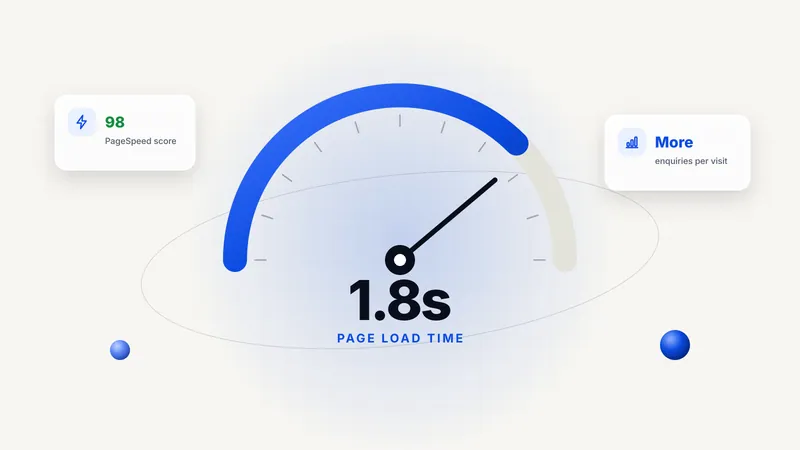
Think about the last time you tapped a link on your phone and stared at a blank screen. You probably didn't wait long. Your customers behave exactly the same way.
A slow website quietly costs you enquiries every day, and you rarely see it happen. Visitors don't complain; they just go back and tap the next result, often your competitor's. This article explains why speed matters so much, how to check your own site, and what actually makes a site fast.
Speed affects three things that matter to you
1. Whether visitors stay
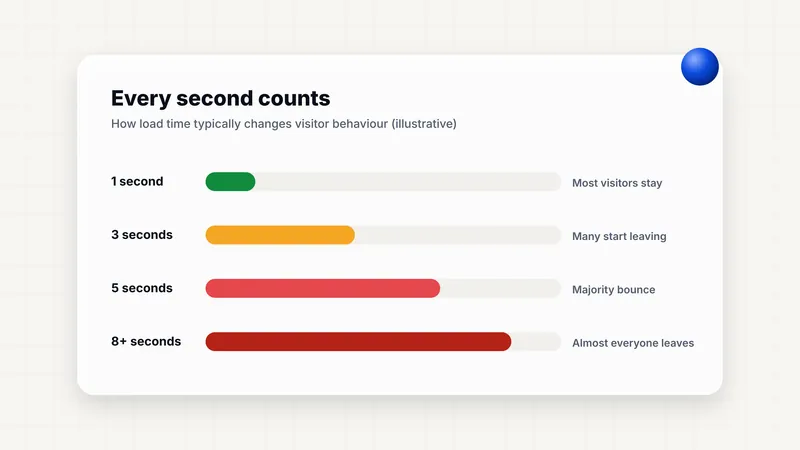
The longer a page takes to show something useful, the more people leave before it does. On mobile data, which is how most people in Andhra Pradesh browse, every extra second hurts more.
2. Where you rank on Google
Google measures real-world loading experience through a set of metrics called Core Web Vitals and uses them as part of its page experience signals. A fast site won't outrank a more relevant one on speed alone, but between two similar businesses, the faster, smoother site has an advantage.
3. How many visitors become customers
Speed shapes trust. A site that loads instantly and responds smoothly feels professional. One that jumps around while loading, or freezes when you tap a button, feels unreliable, and people are less likely to call or fill in a form.
The three Core Web Vitals, in plain language
- Largest Contentful Paint (LCP): how long until the main content (usually the big image or headline) appears. Aim for under 2.5 seconds.
- Interaction to Next Paint (INP): how quickly the page responds when someone taps or clicks. Aim for under 200 milliseconds.
- Cumulative Layout Shift (CLS): how much the page jumps around while loading. Aim for under 0.1.
How to test your website for free
- Go to PageSpeed Insights (pagespeed.web.dev).
- Enter your website address and click Analyse.
- Look at the Mobile tab first, because that's what most of your customers use.
- Check the Core Web Vitals section at the top and the performance score below it.
A score in the green (90–100) is excellent. If your mobile score is in the red, your site is almost certainly losing visitors.
What makes websites slow
In our experience reviewing local business websites, the same problems come up again and again:
- Huge images: photos uploaded straight from a phone camera, often several megabytes each
- Too many plugins: especially on WordPress, where each plugin can add its own scripts and styles
- Heavy page builders and themes: that load code for features the site never uses
- Sliders and auto-playing videos at the top of the page
- Cheap or overloaded hosting that takes a long time to respond
- Too many third-party scripts: chat widgets, trackers and embeds loading all at once
The fixes that make the biggest difference
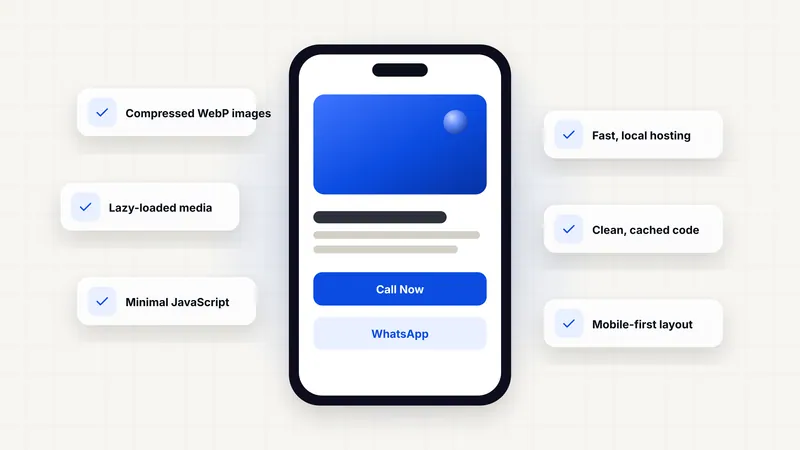
Compress and resize images. Convert photos to modern formats like WebP and serve smaller versions to phones. This alone can cut page weight dramatically.
Lazy-load everything below the fold. Images and maps further down the page should only load when the visitor scrolls to them.
Use less JavaScript. The fastest sites send plain HTML and only add scripts where they genuinely improve the experience.
Reserve space for images and embeds. Setting image dimensions stops the page from jumping as it loads, which fixes layout shift.
Choose good hosting and caching. Proper caching and compression rules mean returning visitors load pages almost instantly.
Keep the top of the page simple. A clear headline, one strong image and a call-to-action button loads faster and converts better than a heavy slider.
Fast doesn't have to mean boring
A common worry is that a fast website must look plain. It doesn't. Modern techniques let you have rich design, animation and even 3D elements, as long as they're loaded smartly: show a lightweight version first, then add the extras once the page is ready.
That's exactly how we build our own site and our clients' sites.
The bottom line
Your website's speed is part of your customer service. Every visitor who leaves because a page was slow is a lost call, booking or sale. Test your site today; if the mobile score is low, it's one of the highest-return fixes you can make.
Want to know how your website stacks up? Get in touch and we'll run a free speed and SEO check, and explain the results in plain language.